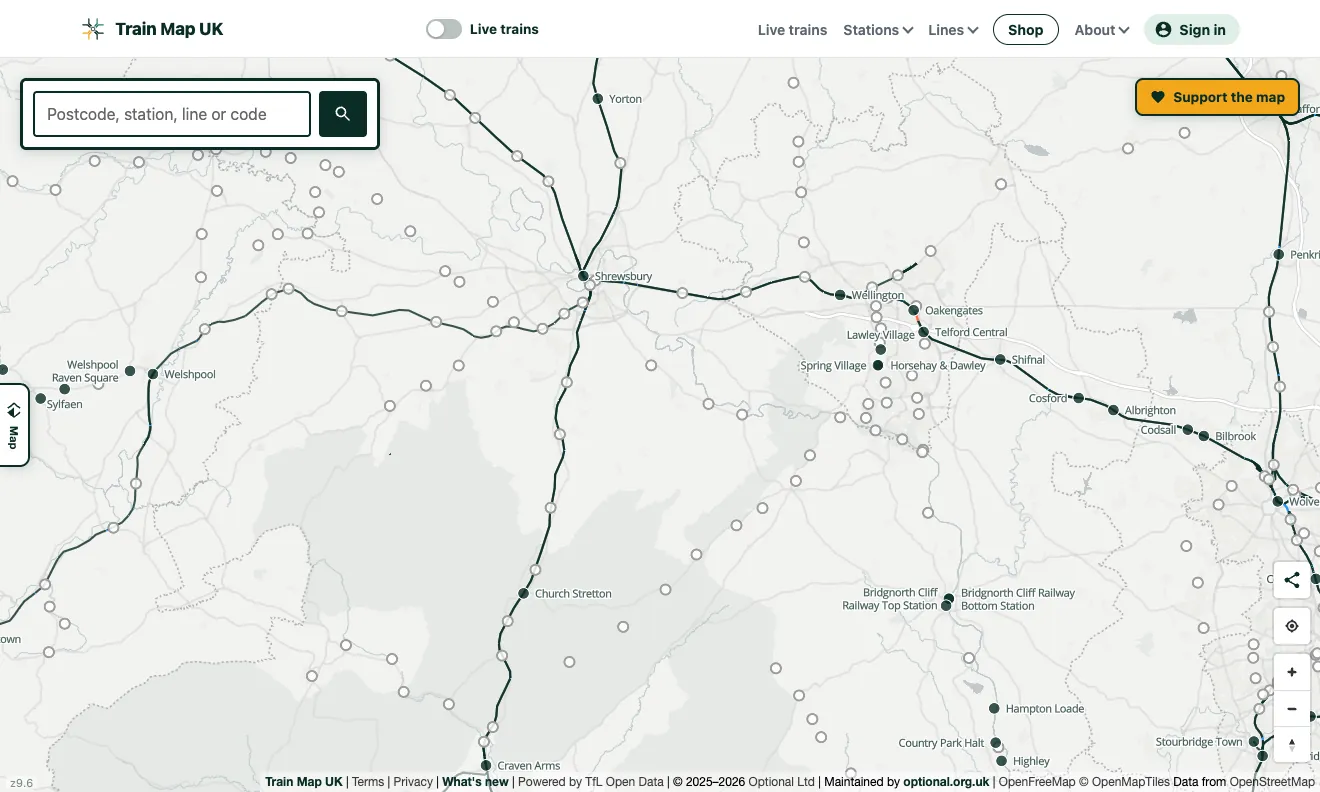
Find the lost station near you
Switch on the Closed / former stations layer and the stations that no longer exist appear as hollow markers alongside today's network. Search a postcode, town or station name. When the layer is on you can search the former stations too, so typing “Box” takes you to the long-closed station at Box in Wiltshire, not just the one still open nearby.
Tap a station to read its story
Each former station links straight to its Wikipedia article where one exists, and to its location on Google Maps. It's a quick way to go from “there used to be a station here” to the full history of when it opened, who it served and why it closed.
Nearly twice as many closed as open
There are 6,136 closed and former stations on the map, against 3,235 still open. Britain has closed almost two stations for every one it still runs. They are not all Beeching, either: hundreds went in the 1930s as buses took over rural routes, and some halts lasted only a few years from opening.
99% of them link to a Wikipedia article, so almost every marker you tap leads to the full story of when it opened, who built it, what it served and why it went.
Where the data comes from
The closed stations come from Wikidata, the open knowledge base behind Wikipedia. We take its record of British railway stations and keep the ones that are not within a few hundred metres of a station still in use, which surfaces genuinely closed stops, sometimes ones Wikidata itself hasn't formally flagged as closed.
Every closed station in your county
The same stations are listed county by county: one page for each county with every closed station in it, A to Z, alongside the lost lines they sat on and how much of the county's railway has gone. Start with North Yorkshire, Lincolnshire, Devon or Lancashire.
Pairs with the disused lines
Closed stations make most sense next to the disused and abandoned lines they once sat on. Switch both on to see the lost network in full. Many closed stations have since reopened as part of a heritage railway, and on the same map you can watch live trains running through the ones that are still open.