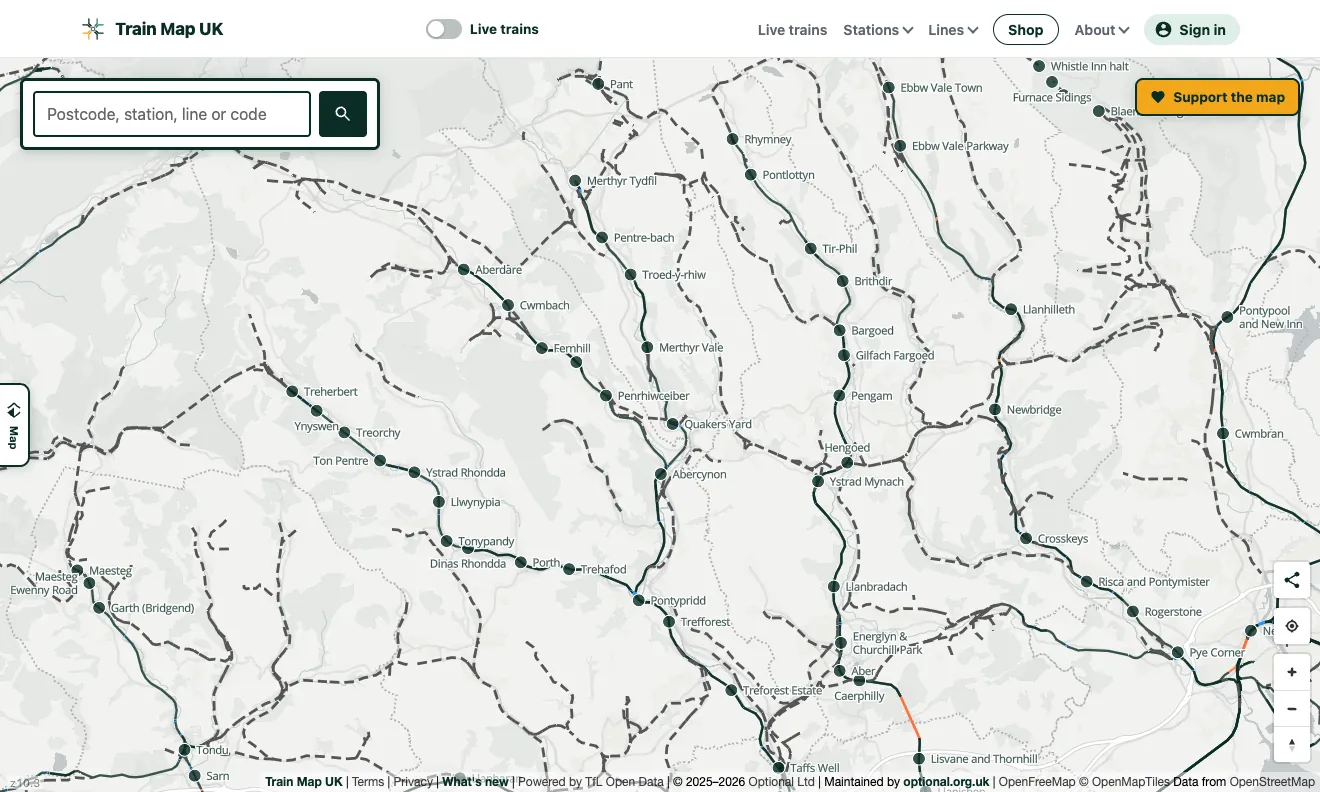
See the network that used to be
Switch on the Disused & abandoned layer and the closed network appears over today's railways, drawn as grey dashed lines. You can follow a line from a junction that still exists out to the village it once served, and see just how dense the pre-Beeching map really was.
To explore your own area, search a postcode or town, then turn the layer on. The trackbed of the line that used to run past you is often still there, as an embankment, cutting or footpath.
What counts as “disused”
The layer covers railways tagged in OpenStreetMap as disused, abandoned, razed or dismantled: everything from lines closed but still physically in place, to routes where the track was lifted long ago and only the alignment remains. Hover or tap a line to see its name where one is recorded.
How much has been lost
The map carries about 20,828 km of disused railway, against roughly 37,289 km still in use. Put another way, for every three kilometres of working railway in Britain there are nearly two more that have closed. Of those lost routes, 3,528 carry a recorded name, including:
- Somerset & Dorset Railway
- Great Central Railway
- Banbury & Cheltenham Direct Railway
- Ruabon & Barmouth Line
- Bala & Festiniog Railway
- Peebles Branch
- Andoversford Line
- Trafford Park Railway
- Bicester Military Railway
- Derbyshire Extension Branch
Where the data comes from
Every line is taken straight from OpenStreetMap, mapped by people who have walked, surveyed and researched these routes. Nothing is invented or generated. It is the community's record of Britain's former railways, rendered on a single map.
What the layer does not show
Two limits worth knowing before you read anything into a blank stretch of map.
Coverage is uneven. Everything here was surveyed and mapped by an OpenStreetMap contributor. Where a trackbed survives as a footpath, an embankment or a cutting it is usually recorded in detail. Where a line was built over by a housing estate or ploughed back into a field there is often nothing left to map, and so nothing appears here. A gap means nobody has mapped that stretch, not that no railway ran there. This is the best available record of Britain's lost railways rather than a complete one.
Not every grey dashed line is a closed railway. Where a route was singled instead of closed, the second track was lifted and OpenStreetMap records the empty formation under the line's own name. Some 41 km of the West of England Line between Templecombe and Wilton, just west of Salisbury, is mapped that way: the stretch singled in 1967, a few metres from rails that carry trains to Exeter every day. Those are now labelled closed track, line still open, and the 102 routes that turn out to be lifted track from end to end are no longer counted among the lost lines above.
The lost lines in your county
Every named disused line is also listed county by county, with the mileage inside each county, what state the trackbed is in and every closed station beside it. North Yorkshire has the most lost railway of any English county; County Durham the most named lines, from the colliery branches that once covered it.
Pairs with the closed stations
Disused lines pair naturally with the closed and former stations layer. Switch both on to see the lost lines and the lost stops together. And where a closed line has been brought back to life, you'll find it on the heritage railways layer instead. For the network as it is today, watch live trains moving across it.