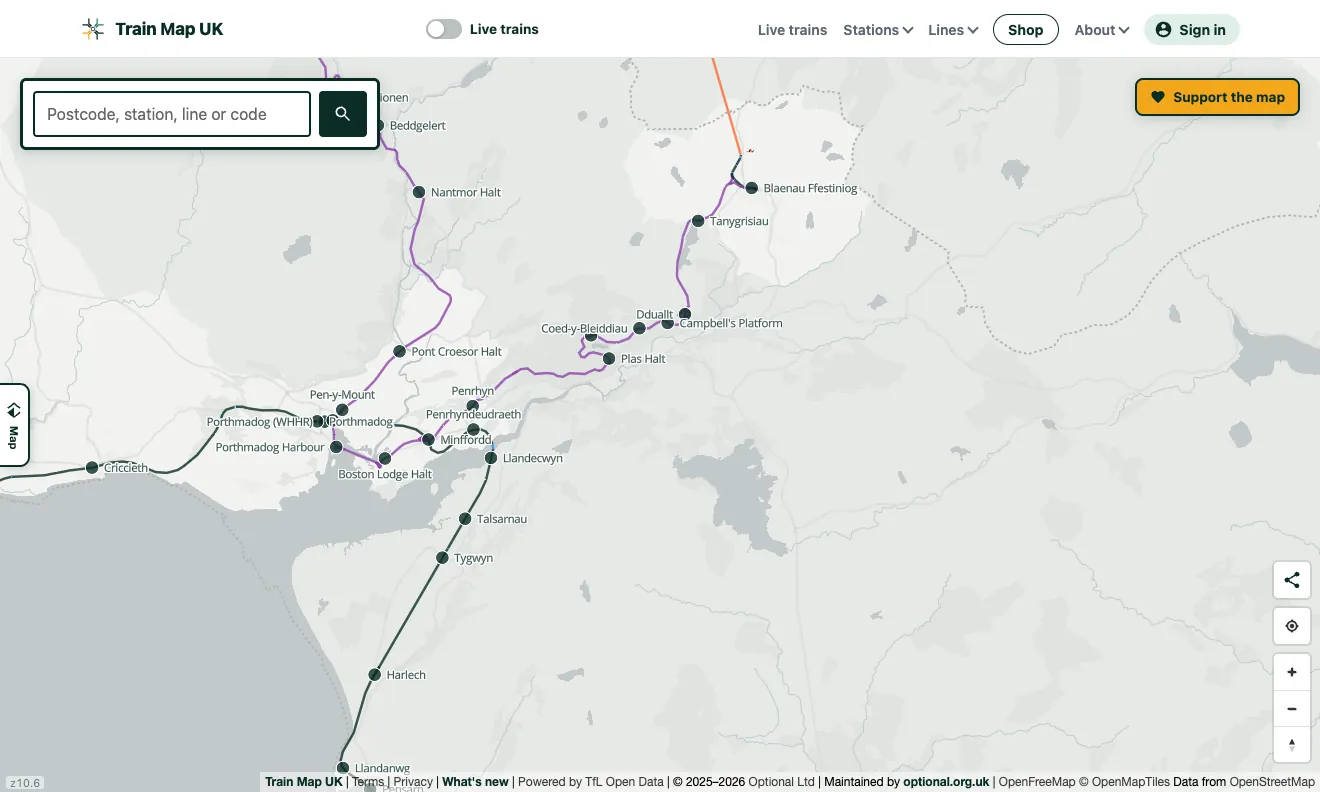
Heritage lines, in purple
Preserved railways are drawn in purple, distinct from today's green national network. Open the map with heritage lines highlighted and the standard network steps back, so lines like the Swanage Railway stand out clearly. You can also search a heritage line by name and the map will fly straight to it.
Full lines, not just fragments
Heritage railways are often tagged inconsistently, a running line here, a depot there, so a line can look broken on other maps. We propagate the heritage flag across every segment that shares a line's name, so a railway like Swanage shows in the heritage colour along its whole length rather than in patches. Narrow-gauge lines such as the Romney, Hythe & Dymchurch are included too.
Every heritage railway on the map
There are 288 named stretches of preserved railway on the map, about 1,237 km of track, run by around 120 railways. Every one of them is listed here, with a link to its own website and, where it sells online, its tickets. Pick a heritage line on the map and the same links appear on its card. Listing is free, and we are happy to add or correct a link: write to us from the contact page.
- Alford Valley Railway (tickets)
- Almond Valley Light Railway (tickets)
- Aln Valley Railway (tickets)
- Amberley Museum Railway
- Avon Valley Railway
- Bala Lake Railway (tickets)
- Battlefield Line Railway (tickets)
- Bluebell Railway (tickets)
- Bo'ness and Kinneil Railway (tickets)
- Bodmin & Wenford Railway (tickets)
- Brecon Mountain Railway (tickets)
- Bristol Harbour Railway
- Bure Valley Railway (tickets)
- Caledonian Railway (Brechin)
- Cambrian Heritage Railways (tickets)
- Chinnor and Princes Risborough Railway (tickets)
- Cholsey & Wallingford Railway (tickets)
- Churnet Valley Railway (tickets)
- Cleethorpes Coast Light Railway (tickets)
- Colne Valley Railway (tickets)
- Corris Railway (tickets)
- Crowle Peatland Railway
- Dartmouth Steam Railway (tickets)
- Dean Forest Railway (tickets)
- Derwent Valley Light Railway (tickets)
- Devon Railway Centre (tickets)
- Doon Valley Railway (tickets)
- East Anglian Railway Museum
- East Kent Railway (tickets)
- East Lancashire Railway (tickets)
- East Somerset Railway (tickets)
- Ecclesbourne Valley Railway (tickets)
- Eden Valley Railway (tickets)
- Embsay & Bolton Abbey Steam Railway (tickets)
- Epping Ongar Railway (tickets)
- Evesham Vale Light Railway
- Fawley Hill Railway
- Fenland Light Railway (tickets)
- Ffestiniog & Welsh Highland Railways (tickets)
- Fife Heritage Railway
- Foxfield Railway (tickets)
- Garw Valley Railway
- Giant's Causeway & Bushmills Railway
- Gloucestershire Warwickshire Railway (tickets)
- Great Central Railway (tickets)
- Great Central Railway (Nottingham)
- Gwili Railway (tickets)
- Hayling Seaside Railway
- Heatherslaw Light Railway
- Helston Railway
- Hythe Pier Railway
- Isle of Wight Steam Railway (tickets)
- Keighley and Worth Valley Railway (tickets)
- Keith and Dufftown Railway (tickets)
- Kent and East Sussex Railway (tickets)
- Kirklees Light Railway (Whistlestop Valley)
- Lakeside and Haverthwaite Railway (tickets)
- Lappa Valley Steam Railway (tickets)
- Launceston Steam Railway (tickets)
- Lavender Line (tickets)
- Lea Bailey Light Railway
- Leadhills and Wanlockhead Railway (tickets)
- Leighton Buzzard Light Railway (tickets)
- Lincolnshire Coast Light Railway
- Lincolnshire Wolds Railway (tickets)
- Llanberis Lake Railway (tickets)
- Llanelli & Mynydd Mawr Railway
- Llangollen Railway (tickets)
- Lynton and Barnstaple Railway (tickets)
- Mangapps Railway Museum
- Mid Suffolk Light Railway
- Mid-Norfolk Railway
- Middleton Railway (tickets)
- Midland Railway Butterley
- Nene Valley Railway (tickets)
- North Dorset Railway
- North Norfolk Railway (tickets)
- North Tyneside Steam Railway
- North Yorkshire Moors Railway (tickets)
- Northampton & Lamport Railway
- Old Kiln Light Railway (tickets)
- Peak Rail (tickets)
- Perrygrove Railway (tickets)
- Plym Valley Railway
- Pontypool & Blaenavon Railway (tickets)
- Ravenglass and Eskdale Railway (tickets)
- Ribble Steam Railway
- Rother Valley Railway
- Royal Deeside Railway (tickets)
- Rushden, Higham and Wellingborough Railway
- Severn Valley Railway (tickets)
- Sittingbourne and Kemsley Light Railway (tickets)
- Snowdon Mountain Railway (tickets)
- Somerset & Dorset Railway (Midsomer Norton) (tickets)
- South Devon Railway (tickets)
- South Tynedale Railway (tickets)
- Spa Valley Railway (tickets)
- Stainmore Railway
- Steeple Grange Light Railway (tickets)
- Strathspey Railway (tickets)
- Swanage Railway (tickets)
- Swindon & Cricklade Railway (tickets)
- Talyllyn Railway (tickets)
- Tanat Valley Light Railway
- Tanfield Railway (tickets)
- Teifi Valley Railway
- Telford Steam Railway (tickets)
- Vale of Rheidol Railway (tickets)
- Volk's Electric Railway
- Watercress Line (Mid Hants) (tickets)
- Weardale Railway (tickets)
- Wells & Walsingham Light Railway (tickets)
- Welsh Highland Heritage Railway (tickets)
- Welshpool & Llanfair Light Railway (tickets)
- Wensleydale Railway (tickets)
- West Lancashire Light Railway
- West Somerset Railway (tickets)
- Westonzoyland Light Railway
- Yorkshire Wolds Railway
Search any of them by name and the map flies straight to it. Narrow-gauge lines are in here too, from the Romney, Hythe & Dymchurch on the Kent coast to the slate railways of North Wales.
Where the data comes from
Heritage lines come from OpenStreetMap, flagged where contributors have tagged a railway as preserved or as tourism/heritage use. As with the rest of the map, it is real surveyed data, not invented.
Once closed, now reopened
Many heritage railways are stretches of line that were once closed and abandoned before being reopened, and they often run through former stations that have been brought back to life. Switch those layers on to see the bigger picture. You can also watch live trains running on today's network, or see the London Underground in real geography.