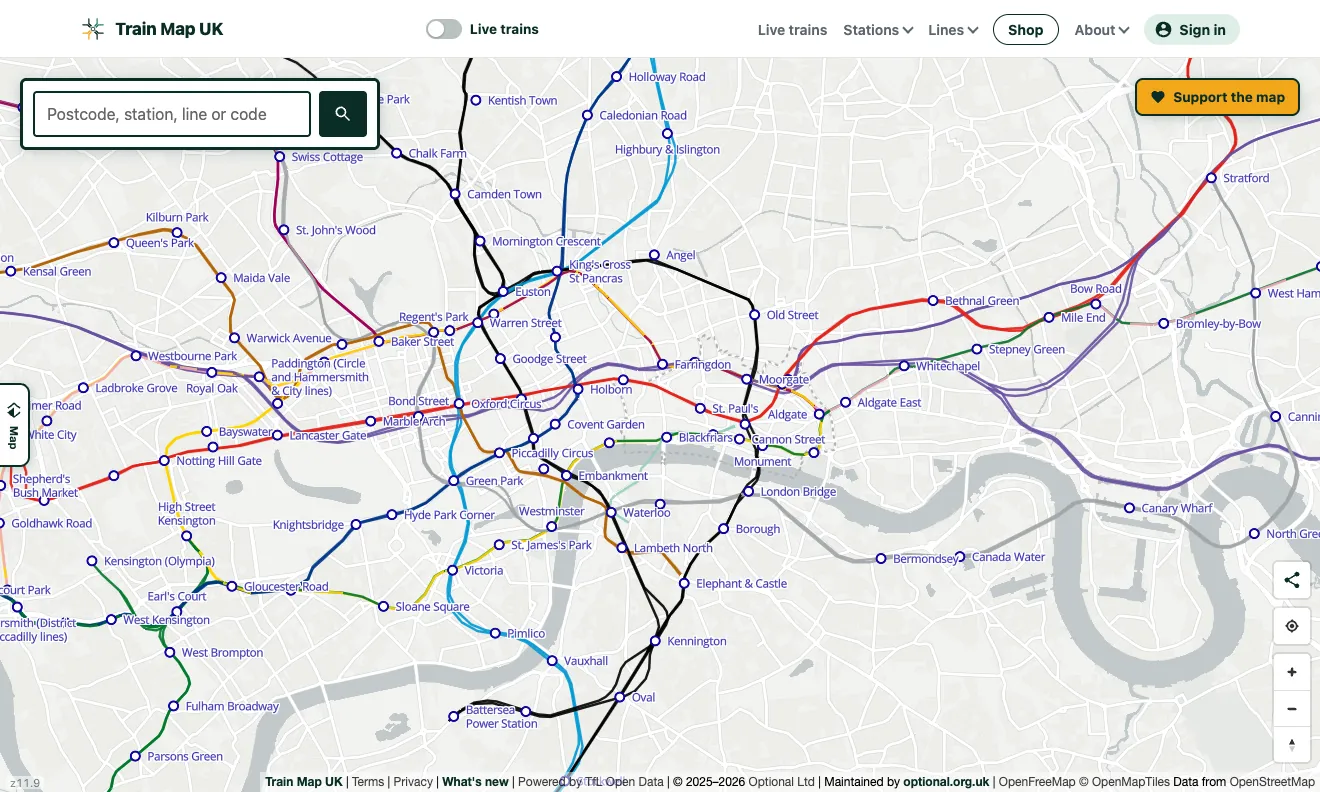
Real distances, real shapes
Switch on the London Underground layer and every line appears where it physically runs, so you can finally see how close two stations on different lines really are, where the lines run side by side, and just how far out into the suburbs the Metropolitan and Central lines reach. Every Underground station can be shown too.
The official line colours
Each line is drawn in its proper colour, so the network reads at a glance. Hover or tap a line to confirm which one it is.
- Bakerloo, brown
- Central, red
- Circle, yellow
- District, green
- Hammersmith & City, pink
- Jubilee, silver-grey
- Metropolitan, magenta
- Northern, black
- Piccadilly, dark blue
- Victoria, light blue
- Waterloo & City, turquoise
- Elizabeth line, purple
The Elizabeth line is not part of the Underground (it is a National Rail service run for TfL), but it is on every Tube map, so it is on this layer too: Reading and Heathrow in the west, through the new tunnels under the centre, to Shenfield and Abbey Wood in the east.
Switch on the station layer as well and all 270 Underground stations appear as hollow blue rings, each one tappable for its Wikipedia article.
How it's built
The Underground is mapped in OpenStreetMap as route relations, which is how we colour each section by its line. It sits as its own switchable layer on top of the full national network, so you can see the Tube in the context of the mainline railways, not in isolation.
Part of the whole railway map
The same map carries the whole of Britain's railways, including disused lines, closed stations and heritage railways, so you can explore well beyond the capital. Turn on live trains to see mainline services moving through London in real time.
The same map, as a print
This map is also a poster: the Underground drawn where it actually runs, 50 x 70 cm on 170 gsm silk, printed in the UK and posted rolled in a tube, with UK delivery included. There are two. The 2026 print is dated in its title and redrawn each year as the network changes. The limited first edition is fifty numbered copies, with the number printed into the artwork rather than written on the back.